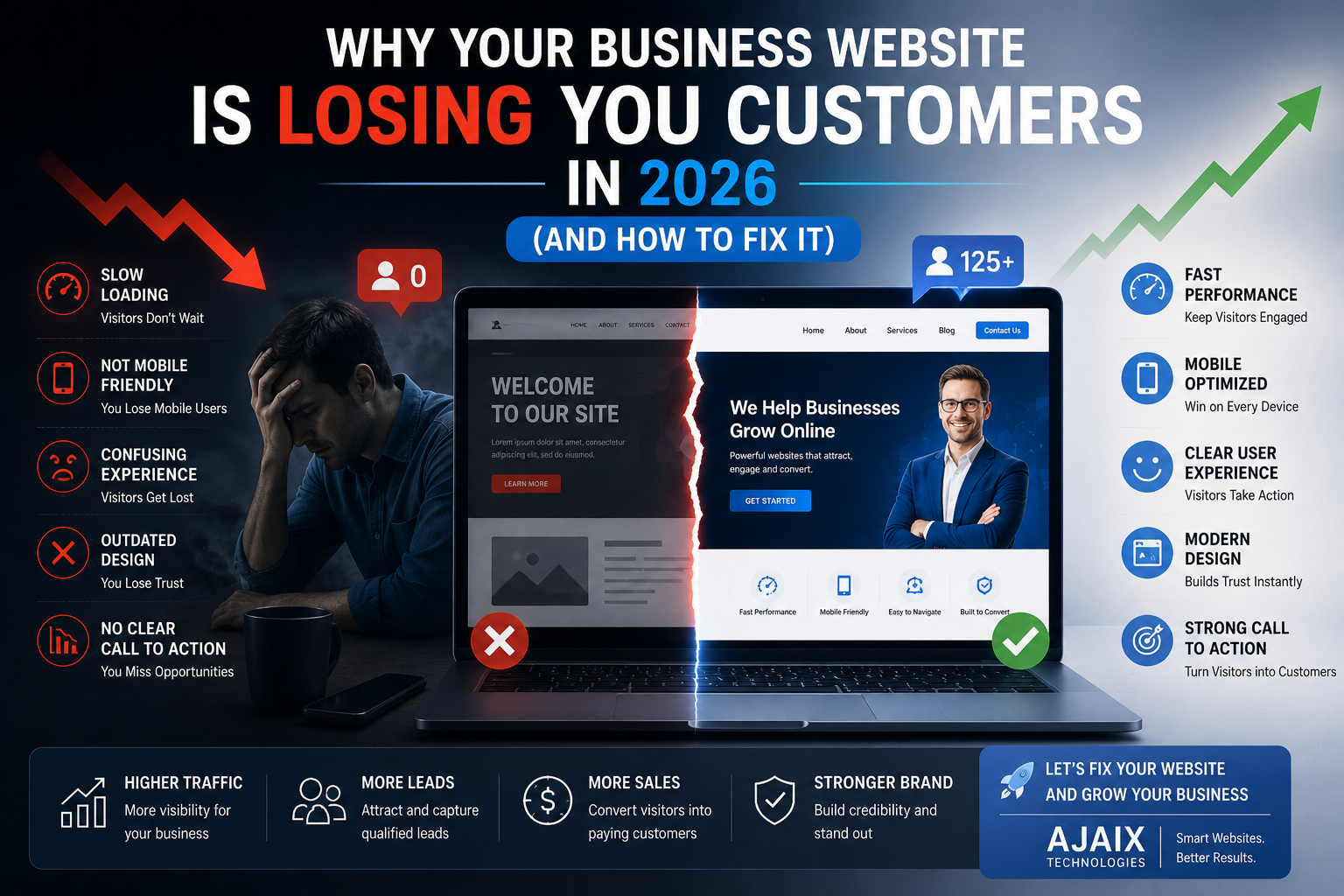
Why Your Business Website Is Losing You Customers in 2026 (And How to Fix It)
Most business websites are quietly driving customers away — through slow load times, poor mobile experiences, outdated design, and weak trust signals. Here is how to diagnose the problem and fix it before it costs you more.
Why Your Business Website Is Losing You Customers in 2026 (And How to Fix It)
Your business website is not a brochure. It is your highest-leverage sales asset — working around the clock, fielding first impressions from every potential customer who searches for what you offer, every competitor who evaluates your credibility, every partner who decides whether to take your call.
Which is why it is so costly when it quietly fails.
The uncomfortable reality is that most business websites are losing customers every single day — not through dramatic failures, but through a slow accumulation of friction points, trust gaps, and missed expectations that send visitors elsewhere before they ever contact you.
The even more uncomfortable reality: the business owners and leaders responsible for those websites often have no idea it is happening. Traffic analytics show visitors arriving. What they do not show — at least not obviously — is the invisible queue of people who arrived, formed a negative impression in under eight seconds, and left to find a competitor whose website did not make them work so hard.
This guide identifies the ten most common reasons business websites lose customers in 2026, explains why each one matters more than ever, and gives you a clear picture of what fixing it actually looks like.
Table of Contents
- Your Website Is Too Slow
- Your Mobile Experience Is Broken
- Visitors Cannot Tell What You Do in Five Seconds
- Your Website Looks Like It Was Built in 2015
- You Have No Credibility Signals
- Your Navigation Makes People Work Too Hard
- Your Calls to Action Are Weak or Missing
- Your Website Is Not Ranking on Google
- Your Contact Process Creates Too Much Friction
- Your Website Cannot Be Trusted on Security
- How to Diagnose Your Website's Biggest Problems
- What a High-Converting Business Website Looks Like in 2026
- Why Ajaix Technologies Builds Websites That Convert
- Frequently Asked Questions
1. Your Website Is Too Slow {#too-slow}
Speed is not a technical metric. It is a customer experience. And in 2026, customer tolerance for slow websites has reached an all-time low.
Research consistently shows that the majority of visitors abandon a website that takes more than three seconds to load. On mobile — where the majority of web traffic now originates — the threshold is even less forgiving. Every additional second of load time compounds the abandonment rate, and the customers who leave rarely come back.
The business impact is direct and measurable. A website that loads in one second converts visitors at dramatically higher rates than one that loads in five seconds — even when the content and offering are identical. Speed is not a nice-to-have. It is a conversion lever.
Why It Happens
Slow websites in 2026 are almost always the product of one or more of these causes: unoptimized images that are ten times larger than they need to be, cheap shared hosting that cannot serve pages quickly under load, bloated WordPress themes loaded with unused plugins and scripts, no content delivery network (CDN) distributing assets close to users, and frontend code that forces browsers to download far more JavaScript than the page actually needs.
What Fixing It Looks Like
A properly built website in 2026 scores 90+ on Google's Core Web Vitals across all three metrics — Largest Contentful Paint, Cumulative Layout Shift, and Interaction to Next Paint. This requires modern image formats (WebP/AVIF), lazy loading, a CDN, server-side rendering or static generation for instant HTML delivery, and a disciplined approach to JavaScript bundle size. It is not optional — it is the baseline for a competitive business website.
2. Your Mobile Experience Is Broken {#mobile-broken}
More than 60% of global web traffic now comes from mobile devices. In many industries — retail, hospitality, professional services, healthcare — the proportion is significantly higher. If your website delivers a poor experience on a smartphone, you are delivering a poor experience to the majority of your visitors.
A broken mobile experience does not necessarily mean a website that fails to load on mobile. More often it means a website that technically displays on mobile but was clearly designed for desktop — with text that is too small to read without pinching, buttons that are too close together to tap accurately, navigation menus that obscure content, forms that are painful to fill out on a touchscreen, and content that extends beyond the screen edge.
These are not minor inconveniences. To a mobile visitor, a difficult-to-use website communicates one thing clearly: this business does not care about my experience. And a business that does not care about the experience of a prospect is unlikely to care about the experience of a customer.
What Fixing It Looks Like
Mobile-first design is the industry standard in 2026 — meaning the mobile experience is designed first and the desktop experience scales up from it, rather than the reverse. Every interactive element must be touch-friendly with adequate tap targets. Typography must be legible without zooming. Navigation must be designed for thumb reach on a phone screen. Forms must minimize typing and use appropriate mobile input types. Load performance on mobile must meet the same standards as desktop.
3. Visitors Cannot Tell What You Do in Five Seconds {#unclear-value}
You have approximately five seconds — probably less — to answer the most fundamental question every new visitor arrives with: What is this, and is it relevant to me?
If your homepage hero section leads with your company name, a vague tagline, and a generic stock photo of people in a meeting room shaking hands, you are failing this test. Visitors do not know what you do, who you serve, or why they should care — and rather than spending time figuring it out, they leave.
This is one of the most common and most costly problems on business websites — and one of the most fixable. Clarity converts. Cleverness confuses.
What Fixing It Looks Like
Your homepage — specifically your above-the-fold section — must answer three questions immediately and unambiguously: what do you do, who do you do it for, and what is the outcome you deliver. Not your mission statement. Not your company values. Not an award you won in 2019. The specific, concrete answer to what a visitor gains by choosing you.
A strong hero section in 2026 leads with a benefit-focused headline, a one-sentence supporting statement that qualifies the audience, a single clear call to action, and a visual element that reinforces rather than distracts from the message. This is not an area for creative ambiguity — it is an area for relentless clarity.
4. Your Website Looks Like It Was Built in 2015 {#outdated-design}
Design is not decoration. It is communication. The visual quality of your website signals the quality of your business — and visitors make this judgement instantly, below the level of conscious thought, before they have read a single word.
A website that looks dated — heavy drop shadows, generic stock imagery, cluttered layouts, inconsistent typography, outdated color palettes — communicates that the business behind it is similarly dated. It raises questions about whether the company is still active, still invested in quality, still capable of delivering modern results.
In competitive markets, where multiple credible options are available to every customer, design quality is often the deciding factor in whether a visitor stays long enough to evaluate your actual offering.
What Fixing It Looks Like
Modern business website design in 2026 is characterized by generous white space, purposeful typography with a clear hierarchy, authentic photography or high-quality custom illustration (not generic stock), a coherent color system that reflects the brand, and interaction design that feels considered rather than accidental. It does not need to be elaborate — the best business websites are often strikingly simple. What they are not is inconsistent, cluttered, or visually stuck in a previous decade.
5. You Have No Credibility Signals {#no-credibility}
Trust is the prerequisite for every conversion. Before a visitor considers contacting you, requesting a quote, or making a purchase, they need to answer a question they may not even consciously articulate: Can I trust these people?
A website that offers no credible evidence of trustworthiness — no client testimonials, no case studies, no recognizable logos, no team information, no verifiable credentials, no third-party review integration — forces visitors to take a leap of faith that most are not willing to take. Particularly in B2B and professional services, where the stakes of choosing the wrong partner are high, absent credibility signals are a significant conversion barrier.
What Fixing It Looks Like
A credible business website in 2026 does not just assert quality — it demonstrates it. Client testimonials with real names, titles, and photographs. Case studies with specific, measurable outcomes. Logos of recognizable clients or partners. Integration of verified third-party reviews (Google, Trustpilot, Clutch). Team profiles that humanize the business. Industry certifications or memberships where relevant. Awards or media coverage where genuine. Each of these signals reduces perceived risk and moves visitors closer to conversion.
6. Your Navigation Makes People Work Too Hard {#bad-navigation}
Navigation is the architecture of your website — and poor architecture means visitors cannot find what they are looking for. When finding information requires effort, most visitors choose not to make the effort.
Common navigation failures include: too many top-level items competing for attention, labels so clever they obscure their meaning, critical pages buried three levels deep, no clear visual hierarchy distinguishing primary from secondary navigation, and mobile navigation implementations that collapse into unusable accordion menus.
The goal of navigation is not to showcase everything your business offers. It is to get the right visitor to the right information in the fewest possible clicks.
What Fixing It Looks Like
Effective website navigation in 2026 is ruthlessly prioritized. Typically five to seven top-level items maximum, labeled with the words visitors actually use rather than internal company jargon, organized around visitor intent rather than company org chart. A persistent, accessible navigation on mobile that does not require three taps to open. A search function for content-heavy sites. Footer navigation that catches visitors who scroll past the header. And a visual design that makes the current location in the site always obvious.
7. Your Calls to Action Are Weak or Missing {#weak-cta}
A visitor who is interested but unclear about what to do next will do nothing. Your website's job is not just to inform — it is to guide interested visitors toward the next step in a relationship with your business. Calls to action (CTAs) are the mechanism for doing this, and most business websites do them badly.
Common CTA failures: buried at the bottom of long pages, using generic copy ("Learn More", "Click Here", "Submit") that communicates no value, competing with too many other CTAs for attention, styled so subtly they are easy to miss, or entirely absent from pages where a clear next step should be obvious.
What Fixing It Looks Like
Every page of your website should have a single primary CTA — one clear, specific action you want the visitor to take from that page. The copy should communicate value and reduce friction: "Book a Free Consultation" beats "Contact Us". "Get Your Custom Quote" beats "Submit". "See How We've Helped Businesses Like Yours" beats "Case Studies". CTAs should be visually prominent, placed at logical decision points throughout the page (not just at the bottom), and consistent in their design language across the site so visitors recognize them as interactive.
8. Your Website Is Not Ranking on Google {#not-ranking}
A fast, beautiful, credible, user-friendly website delivers zero value if no one can find it. For most businesses in 2026, organic search is the single highest-intent traffic channel — people searching for what you offer, at the moment they need it, actively evaluating options. If your website does not rank for the queries your potential customers are making, you are invisible to them.
Poor search rankings are the product of technical SEO failures (slow load times, poor mobile experience, missing meta data, no structured data), content gaps (no pages targeting the specific queries your customers use), and authority deficits (few or no credible external sites linking to yours).
What Fixing It Looks Like
Technical SEO fundamentals must be in place: fast load times, mobile optimization, HTTPS, proper meta titles and descriptions, structured data markup, a clean URL structure, and an XML sitemap. Beyond technical foundations, ranking in competitive markets requires content that genuinely answers the questions your customers are asking — not keyword-stuffed filler, but substantive, useful content that earns both search engine rankings and reader trust. And it requires a credibility-building strategy that earns links from relevant, authoritative external sources over time. SEO is not a one-time fix — it is an ongoing investment that compounds in value.
9. Your Contact Process Creates Too Much Friction {#contact-friction}
You have cleared every hurdle — your website is fast, credible, clear, and well-designed. A visitor is ready to reach out. And then your contact process makes them stop.
Contact friction takes many forms: a contact form that asks for ten fields of information before the conversation has even started, a phone number that is not clickable on mobile, an email address listed as a graphic (invisible to spam bots, also invisible to copy-paste), a contact page with no information about response times, or worst of all — no contact mechanism at all on the page the visitor is currently on.
Every additional step between a visitor's intention to contact you and the ability to do so is a conversion that does not happen.
What Fixing It Looks Like
Contact should be effortless. A short, mobile-friendly form asking only for what is genuinely necessary at this stage — name, email, and a brief message is usually sufficient. A visible phone number (click-to-call on mobile) for visitors who prefer it. A clear indication of what happens next and how quickly they can expect a response. Contact options available on every page — not just the contact page. And for businesses where it fits, a live chat or AI assistant to engage visitors in real time rather than asking them to wait for an email response.
10. Your Website Cannot Be Trusted on Security {#security-trust}
In 2026, a website without HTTPS is not just a security risk — it is a trust catastrophe. Every major browser flags HTTP websites as "Not Secure" with prominent warnings that communicate to visitors that the site they are on is unsafe. For a business website, this is fatal to conversion.
But basic HTTPS is now the floor, not the ceiling. Visitors in 2026 are increasingly aware of data privacy and security — and a website that requests personal information without visible trust signals (privacy policy, data handling transparency, secure form indicators) raises alarm bells that send visitors elsewhere.
What Fixing It Looks Like
HTTPS via a valid SSL certificate is the absolute minimum — and it is freely available via Let's Encrypt for any website. Beyond that: a clearly accessible privacy policy that explains how visitor data is handled, visible trust badges on forms and checkout processes where appropriate, secure and properly validated form handling on the backend, and for e-commerce or any site handling payment information, PCI-DSS compliance and clear payment security communication.
11. How to Diagnose Your Website's Biggest Problems {#how-to-diagnose}
Before investing in fixes, identify which problems are costing you the most. These tools give you objective data:
Google PageSpeed Insights — Free tool that scores your website's Core Web Vitals performance on both mobile and desktop and identifies specific technical issues dragging down your score.
Google Search Console — Shows you which queries are bringing visitors to your site, which pages are ranking, and which technical SEO issues Google has identified.
Google Analytics (GA4) — Reveals where visitors drop off, which pages have high bounce rates, how long visitors stay, and which traffic sources convert best.
Hotjar or Microsoft Clarity — Heatmaps and session recordings show you exactly how real visitors interact with your pages — where they click, where they scroll, and where they stop.
Ahrefs or Semrush — Paid tools that show your keyword rankings, organic traffic trends, and backlink profile. Essential for understanding your SEO competitive position.
Manual Mobile Review — Open your website on your own smartphone and attempt to complete every task a customer might want to perform. The problems you encounter are the problems your customers encounter.
12. What a High-Converting Business Website Looks Like in 2026 {#what-good-looks-like}
Synthesizing everything above, a business website that converts visitors into customers in 2026 has these characteristics:
It loads in under two seconds on mobile. It passes Core Web Vitals on both mobile and desktop. It communicates its value proposition clearly within five seconds of arrival. It is designed to contemporary standards with authentic visual content. It builds trust through specific, verifiable credibility signals. Its navigation is simple, intuitive, and organized around visitor intent. Its calls to action are clear, specific, and present throughout the site. It ranks for the search queries its customers actually use. Its contact process requires minimal effort. It is HTTPS-secured with transparent privacy practices.
Not every business website needs to excel on all twelve dimensions simultaneously to improve results. Identifying and fixing the two or three highest-impact problems for your specific situation will produce measurable improvement faster and at lower cost than attempting a complete overhaul of everything at once.
13. Why Ajaix Technologies Builds Websites That Convert {#why-ajaix}
At Ajaix Technologies, we are a full-stack software development company based in Mansehra, Pakistan, specializing in high-performance web development, AI integration, and scalable enterprise architecture.
When we build business websites, we do not treat design and development as separate concerns. We build with performance baked in from the first line of code — not optimized as an afterthought. We design with conversion in mind — not just visual appeal. We implement SEO technically from the foundation — not added as a plugin after launch.
Every website we deliver is:
- Fast by architecture — server-side rendered or statically generated for sub-second load times and strong Core Web Vitals scores
- Mobile-first by design — designed for the device the majority of your customers are using
- Clear in its communication — structured to answer the right questions in the right order for the right visitor
- Built to be found — technically sound SEO foundations with a content structure designed for the queries your customers make
- Trustworthy by construction — HTTPS, proper security practices, and credibility design integrated from the start
- Owned entirely by you — all source code, content, and assets transferred to your organization on completion
We work with businesses that are serious about their digital presence — and serious about results.
Book a free website review with the Ajaix Technologies team →
We will review your current website, identify the highest-impact problems, and give you an honest assessment of what fixing them would involve. No sales pressure. No generic audit report. Just a direct, useful conversation.
14. Frequently Asked Questions {#faq}
How do I know if my website is actually losing me customers? The clearest signals are: high bounce rates in Google Analytics (above 70% on key pages), low average session duration, a high volume of traffic with low enquiry or conversion volume, poor Core Web Vitals scores in Google Search Console, and direct feedback from customers or prospects that they had trouble with your site.
How much does it cost to fix a business website? It depends entirely on what needs fixing. Minor technical and content improvements can be made at low cost. A full redesign and rebuild for a business website typically represents a meaningful investment — but one that pays for itself quickly when the site was previously losing customers at scale.
Should I fix my existing website or rebuild it? If the underlying structure and technology are sound, targeted improvements are often the right approach. If the site is built on outdated technology, has fundamental structural problems, or is so visually dated that a redesign is the only credible path forward, a rebuild is usually more cost-effective than continued patching.
How long does it take to see results from website improvements? Technical fixes and design changes can produce immediate conversion improvements — sometimes measurable within days. SEO improvements typically take three to six months to manifest as meaningful ranking changes, though technical fixes that remove barriers to indexing can show quicker results.
Do I need a completely custom website or can a template work? For many businesses, a well-implemented template or CMS-based website is entirely sufficient. For businesses with specific functionality requirements, complex integrations, or a need for a genuinely differentiated online experience, custom development delivers results that templates cannot.
How often should a business website be updated or redesigned? Content should be updated continuously — fresh, relevant content is a strong SEO signal and a trust signal for visitors. Design and technology should be reviewed every two to three years. If your website is more than four years old without a significant update, it is almost certainly costing you customers.
Your Website Should Be Working Harder Than It Is
Every day your business website falls short of its potential is a day it is sending customers to competitors who invested in getting it right. The problems outlined in this guide are fixable — and fixing them compounds in value every day afterward.
The question is not whether to invest in a website that converts. It is how much longer you can afford not to.
Start with a free website review from Ajaix Technologies →
Ajaix Technologies — Engineering the Future. Based in Mansehra, Pakistan. Serving clients globally. ajaix.com · [email protected]