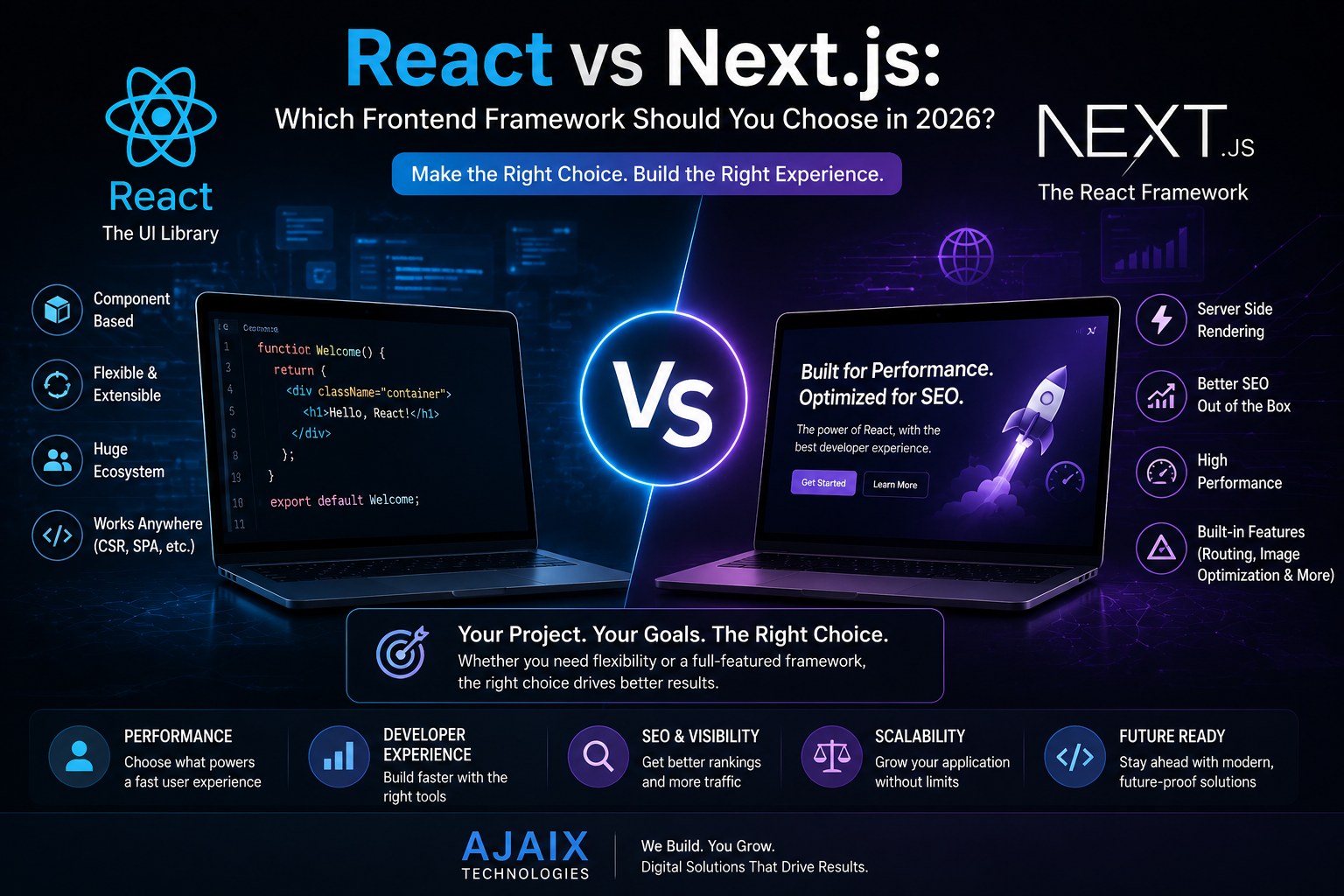
React vs Next.js: Which Frontend Framework Should You Choose in 2026?
React and Next.js are two of the most widely used frontend technologies in the world — but they are not competing alternatives. This guide clarifies exactly what each does, when to use one over the other, and how to make the right choice for your project.
React vs Next.js: Which Frontend Framework Should You Choose in 2026?
If you have spent any time researching modern frontend development, you have almost certainly encountered both React and Next.js — and probably found conflicting advice about which one to choose.
Some articles treat them as direct competitors. Others suggest Next.js is always the better choice. Neither position is accurate — and choosing based on incomplete information leads to projects that are either over-engineered for their requirements or under-equipped for what they actually need to do.
The truth is more nuanced, and once you understand it, the decision becomes straightforward.
This guide gives you a clear, technically honest comparison of React and Next.js across every dimension that matters — rendering strategies, performance, SEO, developer experience, and real-world use cases — so you can make the right call for your specific project.
Table of Contents
- React and Next.js Are Not the Same Kind of Thing
- What Is React?
- What Is Next.js?
- Rendering Strategies: The Core Difference That Changes Everything
- Performance Compared
- SEO: Where the Decision Often Gets Made
- Developer Experience and Project Setup
- Routing: File-Based vs Client-Side
- Full-Stack Capabilities
- Ecosystem, Community, and Long-Term Support
- When to Choose React (Without Next.js)
- When to Choose Next.js
- Side-by-Side Comparison Table
- What Ajaix Technologies Recommends
- Frequently Asked Questions
1. React and Next.js Are Not the Same Kind of Thing {#not-the-same}
Before comparing them, it is essential to understand what they actually are — because most of the confusion in this debate stems from treating them as equivalent alternatives when they are not.
React is a JavaScript library for building user interfaces. It is a tool for creating components — reusable, composable pieces of UI — and managing how they update when your application's data changes. React itself does not dictate how your application is routed, how it is rendered, or how it is deployed. It is a focused, powerful primitive.
Next.js is a full-featured React framework built on top of React. It takes React as its foundation and adds a complete application layer on top: server-side rendering, static site generation, file-based routing, API routes, image optimization, middleware, and much more.
Put simply: you can use React without Next.js, but you cannot use Next.js without React. Next.js is one way — a very good way — to build a production React application. It is not a replacement for React; it is React with a comprehensive set of production capabilities built in.
2. What Is React? {#what-is-react}
React is an open-source JavaScript library created by Meta (formerly Facebook), first released in 2013. It introduced the concept of component-based UI development to the mainstream — and fundamentally changed how web interfaces are built.
React's core contribution to frontend development is its declarative model: you describe what the UI should look like for a given state, and React efficiently updates the DOM to match. This model, combined with the Virtual DOM for performance optimization and a powerful hooks system for managing state and side effects, makes React one of the most flexible and capable tools for building complex user interfaces.
What React does not include out of the box:
- Server-side rendering
- File-based routing
- Build optimization
- API handling
- Image optimization
- Deployment configuration
These capabilities require either a framework like Next.js, or individual libraries chosen and configured by your team (React Router, Vite, React Query, etc.).
React on its own produces a Single Page Application (SPA) — a client-side rendered application where the browser downloads a JavaScript bundle and renders the UI locally. This approach has significant advantages for certain use cases and meaningful limitations for others.
3. What Is Next.js? {#what-is-nextjs}
Next.js is an open-source React framework created and maintained by Vercel, first released in 2016. It has become the most widely adopted React framework for production applications — and for good reason.
Next.js extends React with a production-ready application layer that includes:
- Multiple rendering strategies — Server-Side Rendering (SSR), Static Site Generation (SSG), Incremental Static Regeneration (ISR), and client-side rendering — selectable per page or per component
- File-based routing — pages and routes defined by your file structure, not manual route configuration
- API Routes — server-side API endpoints written alongside your frontend code
- React Server Components — components that run on the server and stream HTML to the client, reducing JavaScript bundle size
- Built-in image optimization — automatic compression, resizing, and lazy loading via the
<Image>component - Automatic code splitting — each page loads only the JavaScript it needs
- Middleware — server-side logic that runs before a request is fulfilled
- Edge runtime support — deploy logic to globally distributed edge networks for minimal latency
Next.js's most significant advantage over plain React is its rendering flexibility. The ability to choose the right rendering strategy for each part of your application — and to mix strategies within a single project — is what makes it such a powerful production tool.
4. Rendering Strategies: The Core Difference That Changes Everything {#rendering-strategies}
Understanding rendering strategies is the key to understanding why Next.js exists and when you need it. This is the dimension that most directly affects performance, SEO, and user experience.
Client-Side Rendering (CSR) — What Plain React Does
The browser downloads a minimal HTML file and a JavaScript bundle. React runs in the browser, fetches data, and renders the UI on the client. The page appears blank until the JavaScript loads and executes.
Advantages: Rich interactivity, no server required, works well for authenticated, session-specific content.
Disadvantages: Slow initial load on low-powered devices or slow connections, poor SEO (search engines see an empty page initially), no content visible until JavaScript executes.
Server-Side Rendering (SSR) — Next.js
The server renders the full HTML for each request and sends it to the browser. The browser displays content immediately while React "hydrates" the page to make it interactive.
Advantages: Fast initial content display, excellent SEO, works well for frequently updated data.
Disadvantages: Server must render each request, higher server load, slower Time to First Byte (TTFB) than static generation.
Static Site Generation (SSG) — Next.js
HTML is generated at build time and served as static files from a CDN. No server rendering required at request time.
Advantages: Fastest possible load times, infinitely scalable, trivially cacheable, excellent SEO.
Disadvantages: Content is only as fresh as the last build. Not suitable for highly dynamic or personalized content.
Incremental Static Regeneration (ISR) — Next.js
Static pages are generated at build time but can be regenerated in the background at defined intervals — delivering static performance with dynamic content freshness.
Advantages: Best of both SSG and SSR for most content scenarios.
Disadvantages: Brief window where stale content may be served.
React Server Components (RSC) — Next.js App Router
Components execute on the server, stream HTML to the client, and ship zero JavaScript for their own logic. Client components handle interactivity where needed.
Advantages: Dramatically reduced JavaScript bundle size, faster Time to Interactive, efficient data fetching close to the source.
Disadvantages: Newer paradigm with a steeper mental model; not all libraries are compatible yet.
Plain React gives you only CSR. Next.js gives you all of the above — selectable per page or per component.
5. Performance Compared {#performance-compared}
For most real-world projects, Next.js outperforms a plain React SPA on the metrics that matter most to users and businesses.
Core Web Vitals
Google's Core Web Vitals — Largest Contentful Paint (LCP), Cumulative Layout Shift (CLS), and Interaction to Next Paint (INP) — are the performance benchmarks that matter most for both user experience and search ranking.
Next.js's server rendering and static generation deliver content to the browser faster than client-side rendering, directly improving LCP scores. Its image optimization component eliminates the layout shift issues that plague manually managed images. Its automatic code splitting ensures pages load only the JavaScript they need.
A typical marketing website or content-heavy application built with Next.js (SSG/ISR) will consistently outperform the same application built as a plain React SPA on every Core Web Vital.
JavaScript Bundle Size
One of the most impactful recent Next.js capabilities is React Server Components. By moving component logic to the server and shipping only HTML — rather than the JavaScript to render that HTML — RSC reduces the JavaScript bundle that users must download and parse. For large applications, this improvement in Time to Interactive is significant.
When Plain React Performs Comparably
For authenticated dashboard applications — where all content is behind a login, SEO is irrelevant, and the application runs on capable devices on reliable connections — a well-optimized plain React SPA performs comparably to Next.js for the actual user experience. The theoretical performance advantages of SSR matter less when content freshness and interactivity are the primary concerns.
6. SEO: Where the Decision Often Gets Made {#seo}
For many projects, SEO requirements alone determine the framework choice — and here the answer is clear.
Plain React (CSR) has fundamental SEO limitations. While Google's crawler has improved its ability to execute JavaScript and index client-rendered content, it remains slower and less reliable than indexing server-rendered HTML. Other search engines — Bing, DuckDuckGo — and social media crawlers (for Open Graph previews) still struggle significantly with client-rendered content.
For any application where organic search traffic matters — marketing websites, e-commerce, content platforms, blogs, product pages, landing pages — Next.js is the correct choice. Its server rendering and static generation ensure that search engine crawlers receive fully rendered HTML on every request, with no dependency on JavaScript execution for content visibility.
For applications where SEO is genuinely irrelevant — internal tools, authenticated dashboards, admin panels, B2B SaaS applications accessed only by logged-in users — the SEO advantage of Next.js disappears as a deciding factor.
7. Developer Experience and Project Setup {#developer-experience}
Plain React Setup
Starting a plain React project today typically involves Vite (the recommended build tool) or Create React App (now largely deprecated). From there, your team adds routing (React Router), data fetching (React Query or SWR), state management (Zustand, Redux Toolkit, or Jotai), and any other capabilities the project requires.
This flexibility is genuinely valuable for teams that know exactly what they want and have the experience to assemble the right stack. For less experienced teams or teams under time pressure, it introduces decision overhead and integration complexity.
Next.js Setup
Next.js provides an opinionated, production-ready starting point. create-next-app scaffolds a complete project structure with routing, image optimization, font optimization, and TypeScript support pre-configured. The framework makes sensible decisions for you — decisions that experienced teams would make anyway, and that less experienced teams might get wrong.
The App Router (introduced in Next.js 13 and stable from Next.js 14) introduces React Server Components as the default — a meaningful paradigm shift that requires learning investment but delivers significant performance benefits in return.
For most teams, Next.js provides a faster path to a production-ready application than assembling a custom React stack from individual libraries.
8. Routing: File-Based vs Client-Side {#routing}
React Router (Client-Side)
Plain React applications handle routing client-side via React Router (or TanStack Router, an increasingly popular alternative). Routes are defined in code, and navigation happens without full page reloads — maintaining application state across navigations.
This approach is highly flexible and well-suited to complex, state-heavy applications where navigation is primarily between authenticated views.
Next.js File-Based Routing
Next.js derives routes from the file system. A file at app/about/page.tsx automatically becomes the /about route. Nested folders create nested routes. Dynamic segments use bracket notation: app/products/[id]/page.tsx.
This convention is intuitive, eliminates route configuration boilerplate, and makes the application's URL structure immediately visible from the file system. For most applications, it is a productivity advantage over manually configured routing.
The App Router also introduces layouts — shared UI that wraps multiple pages without re-rendering on navigation — and loading and error boundaries at the route level, built into the framework.
9. Full-Stack Capabilities {#full-stack-capabilities}
This is an area where Next.js offers something plain React fundamentally cannot.
Next.js API Routes and Server Actions
Next.js allows you to write server-side API endpoints directly in your frontend project — under the app/api/ directory in the App Router. These endpoints run on the server, can connect to databases, handle authentication, and perform any server-side operation.
Server Actions — introduced in Next.js 13 and stable in Next.js 14 — go further, allowing server-side functions to be called directly from client components without a manually defined API layer. This dramatically simplifies data mutation patterns for many application types.
For projects where a full separate backend is not warranted — content sites with basic data needs, simple forms, lightweight data mutations — Next.js's server capabilities can handle the backend entirely. For complex enterprise applications with extensive business logic, a dedicated backend (Laravel, Node.js, etc.) remains the right choice, with Next.js consuming its APIs on the frontend.
Plain React has no server-side capabilities whatsoever — it is purely a frontend tool that consumes APIs defined elsewhere.
10. Ecosystem, Community, and Long-Term Support {#ecosystem}
React
React is maintained by Meta and has the largest frontend framework community in the world. Its component ecosystem is enormous — virtually every UI library, animation library, form library, and data visualization tool has a React version. Its long-term viability is about as close to guaranteed as any open-source project can be.
Next.js
Next.js is maintained by Vercel — a well-funded company with a strong commercial interest in the framework's success. It has become the de facto standard for production React applications and enjoys a large, active community. The framework has demonstrated consistent, thoughtful evolution over nine years.
One consideration worth noting: Next.js is most naturally deployed on Vercel's platform. It runs perfectly well on other platforms (AWS, Google Cloud, self-hosted Node.js servers, Docker containers), but some features — particularly edge middleware and ISR — are most seamlessly supported on Vercel's infrastructure. This is not a lock-in risk, but it is worth factoring into hosting decisions.
11. When to Choose React Without Next.js {#when-to-choose-react}
Plain React (without Next.js) is the right choice when:
- SEO is genuinely irrelevant — internal tools, authenticated dashboards, admin panels, and enterprise SaaS accessed exclusively by logged-in users
- Your application is highly interactive and state-heavy — where client-side rendering and persistent state across navigation are primary requirements
- You are building a complex SPA where the mental model of a server-rendered application adds unnecessary complexity
- You have a separate, established backend and need only a frontend UI layer with no server-side rendering requirements
- Your team prefers maximum architectural flexibility and has the experience to assemble and maintain a custom React stack effectively
- You are building a React Native mobile application where Next.js's web-specific features are irrelevant
12. When to Choose Next.js {#when-to-choose-nextjs}
Next.js is the right choice when:
- SEO matters — any public-facing application where organic search traffic is a business requirement
- Performance on initial load is critical — marketing sites, e-commerce, content platforms, landing pages where first impression determines bounce rate
- You want rendering flexibility — the ability to choose SSR, SSG, ISR, or CSR per route based on content requirements
- You need lightweight server-side capabilities — API routes or Server Actions for data fetching, form handling, or simple backend logic
- You are building a content-driven application — blogs, documentation sites, product catalogues, news platforms
- You want a production-ready starting point — Next.js's conventions and built-in optimizations accelerate time to production for most project types
- You are building a full-stack JavaScript application — Next.js enables a unified JavaScript/TypeScript codebase from database to UI
13. Side-by-Side Comparison Table {#comparison-table}
| Factor | React (Plain SPA) | Next.js |
|---|---|---|
| Type | UI library | Full React framework |
| Rendering | Client-side only | CSR, SSR, SSG, ISR, RSC |
| SEO | Limited | Excellent |
| Initial load performance | Slower (JS-dependent) | Fast (server-rendered HTML) |
| Routing | Manual (React Router) | Built-in file-based routing |
| Server-side capabilities | None | API Routes, Server Actions |
| Image optimization | Manual | Built-in |
| Bundle optimization | Manual configuration | Automatic code splitting |
| Setup complexity | Higher (custom stack) | Lower (opinionated defaults) |
| Full-stack JavaScript | No | Yes |
| Best for | Dashboards, SPAs, internal tools | Public sites, e-commerce, content apps |
| Learning curve | Moderate | Moderate + RSC paradigm |
| Deployment flexibility | Any static host | Node.js server or static export |
14. What Ajaix Technologies Recommends {#what-we-recommend}
At Ajaix Technologies, we build production applications with both React and Next.js — and our recommendation for every project is based on requirements, not preference.
In practice, the majority of client projects we build use Next.js — because the majority of business applications benefit from its rendering flexibility, built-in optimizations, and full-stack capabilities. For enterprise web applications, customer-facing platforms, e-commerce solutions, and content-driven products, Next.js consistently delivers a better result than a plain React SPA.
We reach for plain React — typically with Vite — for internal tools, complex authenticated dashboards, and applications where client-side rendering genuinely fits the use case better and the overhead of Next.js adds complexity without proportional benefit.
We also commonly combine them: a Next.js frontend for the public-facing, SEO-critical parts of an application alongside a React SPA for the authenticated, interactive dashboard — served from the same codebase or as separate deployments depending on complexity.
The right choice is never the most fashionable one — it is the one that fits your project's actual requirements.
15. Frequently Asked Questions {#faq}
Is Next.js replacing React? No. Next.js is built on React and cannot exist without it. It extends React with production capabilities — it does not replace it. React continues to evolve independently and remains the foundation of Next.js.
Should I learn React before Next.js? Yes. Understanding React's component model, hooks, and state management is essential before adding Next.js's abstractions on top. Next.js makes more sense when you understand what it is adding and why.
Is Next.js good for large enterprise applications? Yes — Next.js is used in production by some of the largest web applications in the world. Its rendering flexibility, performance characteristics, and active development make it well-suited to enterprise scale.
Can Next.js replace a backend entirely? For simple applications: potentially. For enterprise applications with complex business logic, compliance requirements, or extensive data processing: no. Next.js's server capabilities complement a dedicated backend — they do not replace one for serious use cases.
Is Next.js harder to deploy than plain React? A plain React SPA can be deployed as static files to any CDN. Next.js requires a Node.js server for SSR features (or Vercel's platform). Static export mode allows Next.js to be deployed as static files, but disables SSR and API routes. Deployment complexity is marginally higher for full-featured Next.js applications — but the production tooling available (Vercel, Docker, AWS) makes it manageable.
Which is better for e-commerce? Next.js — without question. E-commerce requires excellent SEO, fast initial page loads, and the ability to handle both frequently updated product data and static content. Next.js's ISR and SSR capabilities are precisely what e-commerce applications need.
Not Sure Which Fits Your Project?
The React vs Next.js decision becomes obvious once the project requirements are clearly defined — but getting to that clarity requires asking the right questions.
At Ajaix Technologies, we do this for every project we take on. We assess your performance requirements, SEO needs, team context, and long-term roadmap — and we recommend the technology that genuinely fits, not the one that is easiest to sell.
Book a free frontend architecture consultation with the Ajaix Technologies team →
No commitment. Just a straightforward technical conversation about your project and the right way to build it.
Ajaix Technologies — Engineering the Future. Based in Mansehra, Pakistan. Serving clients globally. ajaix.com · [email protected]