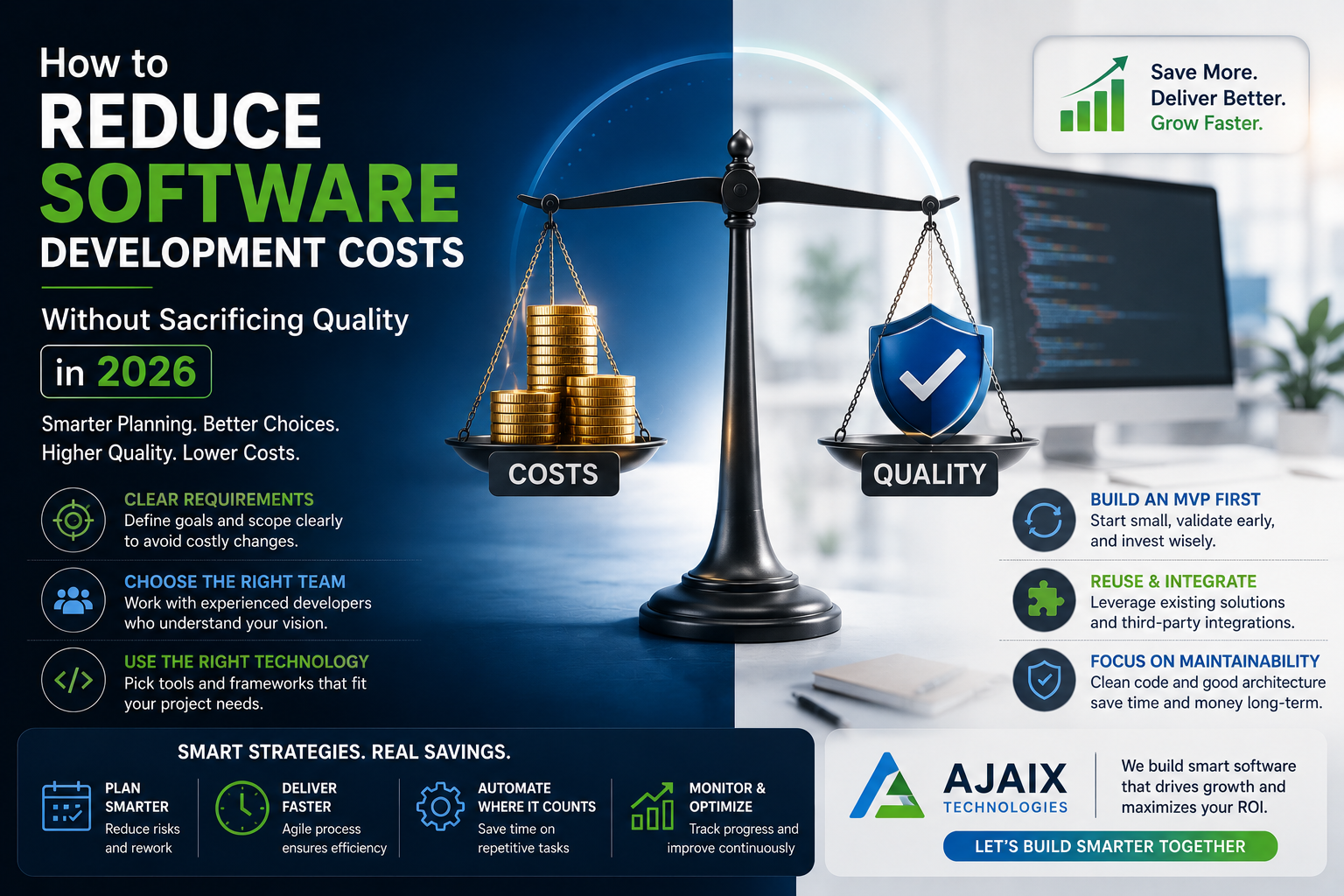
How to Reduce Software Development Costs Without Sacrificing Quality in 2026
Software development does not have to break your budget. Discover the proven strategies that smart businesses use in 2026 to reduce development costs significantly — without cutting corners on quality, security, or long-term maintainability.
How to Reduce Software Development Costs Without Sacrificing Quality in 2026
Software development has a reputation for going over budget. And that reputation, unfortunately, is well-earned — but not for the reasons most people assume.
The majority of software projects that exceed their budget do not do so because development is inherently expensive. They do so because the project was scoped vaguely, the technology choices were made without considering long-term cost, the wrong development model was chosen, or corners were cut in ways that created far more expensive problems downstream.
The good news is that these are all avoidable mistakes. And avoiding them does not require compromising on quality — in fact, the strategies that genuinely reduce software development costs are the same strategies that tend to improve quality, reduce rework, and deliver software that holds up over time.
In 2026, with a mature global talent market, powerful open-source tooling, cloud-native infrastructure, and AI-assisted development practices all available, businesses have more options than ever to build great software cost-effectively. The key is knowing which strategies work, which create hidden costs, and how to apply them intelligently to your specific situation.
This guide gives you exactly that.
Table of Contents
- Why Software Projects Cost More Than They Should
- Strategy 1: Invest Properly in Discovery Before Writing Code
- Strategy 2: Build an MVP First — Validate Before You Scale
- Strategy 3: Choose the Right Technology Stack for the Long Term
- Strategy 4: Work With the Right Development Partner, Not Just the Cheapest
- Strategy 5: Embrace Agile Delivery to Control Scope and Cost
- Strategy 6: Leverage Open-Source and Existing Solutions Intelligently
- Strategy 7: Prioritize Ruthlessly — Not Everything Needs to Be in Version One
- Strategy 8: Invest in Quality Assurance Early, Not Late
- Strategy 9: Design for Maintainability From Day One
- Strategy 10: Use Cloud-Native Infrastructure to Reduce Operational Costs
- Strategy 11: Consider Nearshore and Offshore Development Intelligently
- Strategy 12: Treat Your Development Partner as a Long-Term Investment
- The False Economy of Cutting Corners: What It Actually Costs
- What Ajaix Technologies Delivers for Your Budget
- Frequently Asked Questions
1. Why Software Projects Cost More Than They Should {#why-projects-cost-more}
Before exploring how to reduce costs, it is worth understanding the root causes of unnecessary expense in software development — because most cost-reduction strategies are really just solutions to these underlying problems.
Vague Requirements and Scope Creep
The single biggest driver of budget overruns in software projects is scope creep — the gradual expansion of requirements beyond what was originally agreed and budgeted. Scope creep almost always originates in vague or incomplete requirements at the start of a project. When what needs to be built is not clearly defined, everything is open to interpretation — and interpretations expand.
Wrong Technology Choices
Choosing a technology stack because it is fashionable, because someone on the team is familiar with it, or because the cheapest available developer knows it — rather than because it is the right tool for the job — creates costs that compound over the life of the project. The wrong stack makes development slower, maintenance harder, and scaling more expensive.
Choosing the Cheapest Option Upfront
The development partner or freelancer with the lowest day rate is rarely the most cost-effective choice when total project cost is considered. Slow delivery, poor code quality, inadequate testing, and the need for significant rework after handoff frequently make the "cheapest" option the most expensive one in practice.
Skipping Quality Assurance
Testing and quality assurance are among the first things cut when a project faces budget pressure — and among the most expensive things to cut. Bugs caught during development cost a fraction of the same bugs caught in production. Technical debt accumulated by skipping QA compounds rapidly into a maintenance burden that costs more to carry than the QA would have.
Building Too Much Too Soon
Building a comprehensive, feature-complete application before validating that the core proposition works is one of the most common and costly mistakes in software development. Features that seemed essential in planning often prove unnecessary in practice — and the cost of building them cannot be recovered.
Understanding these root causes makes the strategies below much more intuitive — because each one is designed to address one or more of them directly.
2. Strategy 1: Invest Properly in Discovery Before Writing Code {#discovery}
The single highest-return investment in any software project is a proper discovery phase — a structured period before development begins where requirements are mapped in detail, technical assumptions are validated, architecture decisions are made deliberately, and the project scope is defined with enough precision to support accurate planning and budgeting.
Discovery is not a cost. It is insurance against the far greater cost of building the wrong thing, or building the right thing in the wrong way, and discovering the mistake after significant investment has been made.
What Discovery Prevents
A well-executed discovery phase prevents the most expensive problems in software development: scope disputes between client and developer about what was agreed, architectural decisions that seemed sensible early but prove costly to maintain or scale, integration complexities that were not anticipated until the moment they were encountered, and security or compliance requirements that were not considered until the application was nearly complete.
What Discovery Looks Like in Practice
A proper discovery engagement typically runs two to four weeks and produces a detailed project specification, a validated technical architecture, a risk register identifying known unknowns, and a project plan with milestones and budgets that have been grounded in a real understanding of the work involved. Skipping this phase to save money upfront is one of the most reliable ways to spend significantly more money overall.
3. Strategy 2: Build an MVP First — Validate Before You Scale {#mvp-first}
A Minimum Viable Product (MVP) is the smallest, most focused version of your application that delivers enough value to be genuinely useful to real users — and from which you can gather real feedback to guide further development.
The MVP approach is one of the most effective cost-reduction strategies available, not because it means building something cheap or disposable, but because it defers investment in features that have not yet been validated as necessary. The features you do not build in version one are features you do not pay for — and experience consistently shows that a significant proportion of planned features either prove unnecessary once real users engage with the application, or need to be redesigned based on actual usage patterns before they are worth building.
MVP Thinking Applied to Business Software
For internal business applications, the MVP principle translates to: which core workflow, if digitized and working well, would deliver the most immediate business value? Build that first, to a high standard, and validate it with real users before building everything else.
This approach concentrates early investment on the highest-value features, generates real-world feedback that improves the quality of subsequent features, and avoids the cost of building and then rebuilding features designed in a vacuum.
What MVP Does Not Mean
MVP does not mean low quality, poor security, or technical shortcuts. It means smaller scope — but within that scope, the same engineering standards apply. An MVP built on a fragile foundation is not a cost-saving measure — it is technical debt that will cost more to fix than it saved to create.
4. Strategy 3: Choose the Right Technology Stack for the Long Term {#right-tech-stack}
Technology choices made at the start of a project determine costs for years afterward. A stack chosen for the wrong reasons — short-term availability, passing familiarity, or the preferences of whoever is cheapest — creates compounding costs through slower development, harder maintenance, and more expensive scaling.
The Long-Term Cost Dimensions of Technology Choice
Developer availability: Choosing a technology with a large, active developer community means a larger pool of talent available for ongoing maintenance and development — and competitive market rates. Choosing an obscure or aging technology creates dependency on a small pool of specialists who can charge accordingly.
Framework productivity: Modern, well-designed frameworks with strong conventions and good tooling accelerate development significantly. A framework that requires developers to reinvent solutions to common problems for every project is a framework that makes every hour of development more expensive.
Scalability cost: Some technology stacks scale efficiently and cheaply on modern cloud infrastructure. Others require expensive vertical scaling or complex horizontal architectures to handle growth. The right choice for your expected usage patterns can represent significant savings in infrastructure cost over time.
Maintenance cost: Clean, well-structured code in a mainstream technology stack is relatively inexpensive to maintain. Code in a niche framework, or code that was written quickly without regard for readability and structure, becomes increasingly expensive to work with as the team that built it moves on and the institutional knowledge of its quirks fades.
The right technology choice is the one that fits your project's requirements, your team's expertise, your budget's constraints, and your expected evolution over the next three to five years — not the one that is most fashionable this quarter.
5. Strategy 4: Work With the Right Development Partner, Not Just the Cheapest {#right-partner}
Choosing a development partner on price alone is one of the most reliable paths to a project that costs more than it needed to. The development partner with the lowest day rate who delivers slowly, communicates poorly, produces low-quality code, and requires significant rework is not a cost-saving choice — they are the most expensive option when total cost is honestly calculated.
What the Right Partner Actually Costs You (Less Of)
A high-quality development partner with strong communication, rigorous engineering standards, and deep experience in projects like yours delivers value that goes well beyond the code itself:
- Fewer surprises — because the project was scoped properly upfront and risks were identified early
- Less rework — because the code was built correctly the first time, to a standard that can be extended and maintained without expensive refactoring
- Faster delivery — because experienced teams work efficiently and do not spend time rediscovering solutions to problems they have solved before
- Better decisions — because a partner with relevant experience challenges assumptions that would have led to costly mistakes
The total cost of a software project includes not just the development invoice but the business time invested in managing the relationship, the cost of delays, the cost of rework, and the long-term cost of maintaining whatever was built. Optimizing for day rate while ignoring these factors is a false economy.
How to Evaluate Value, Not Just Price
When comparing development partners, ask for the total cost of a defined scope — not just day rates. Evaluate their discovery process, their engineering standards, their communication practices, and their track record on projects similar to yours. A partner who charges 30% more per day but delivers in 40% less time with 50% less rework is dramatically cheaper in practice.
6. Strategy 5: Embrace Agile Delivery to Control Scope and Cost {#agile-delivery}
Agile development methodology — building in short, iterative cycles called sprints, with regular review and reprioritization — is not just a development philosophy. It is a budget management tool.
In a waterfall project, budget overruns are discovered late — often at the point where the project is already significantly over budget and significantly under-delivered. In an agile project, cost is managed continuously. Each sprint has a defined scope and a defined cost. If priorities change or the scope needs to expand, the decision is made explicitly and its cost impact is understood before the work begins.
How Agile Protects Your Budget
Reprioritization: When new information emerges — a feature proves more complex than estimated, a business requirement changes, a user test reveals that a planned feature is not needed — agile allows scope to be adjusted without derailing the entire project. Lower-priority features can be deferred to a later phase or removed entirely in favour of higher-value work.
Early delivery of value: Agile's incremental delivery means working software is available earlier. In some cases, an early release of core functionality generates value or revenue that offsets further development cost. In all cases, it provides earlier validation that the project is on track.
Visible progress and accountability: Regular sprint reviews give stakeholders clear visibility into progress and spending. Problems are surfaced early when they are cheap to fix, not late when they are expensive to recover from.
7. Strategy 6: Leverage Open-Source and Existing Solutions Intelligently {#open-source}
In 2026, there is an exceptional range of high-quality, production-ready open-source libraries, frameworks, and tools available for virtually every common software development requirement. Using them intelligently is one of the most effective ways to reduce development cost without reducing quality.
What to Build vs What to Buy or Use
The principle is straightforward: do not build what already exists well. Authentication systems, payment processing, email delivery, file storage, search functionality, charting and visualization, PDF generation — these are all problems that have been solved, repeatedly, by open-source communities or commercial services that can be integrated at a fraction of the cost of building equivalent functionality from scratch.
Bespoke development effort should be concentrated on the features that are genuinely unique to your business — the workflows, logic, and capabilities that differentiate your application from a generic solution. Everything else should be assembled from proven, maintained components.
The Open-Source Quality Consideration
Using open-source components does not mean accepting quality risk — it means choosing components thoughtfully. Well-maintained packages with active communities, clear documentation, and strong security track records are often more reliable than custom-built equivalents. The evaluation criteria should include: maintenance activity, community size, security disclosure history, license compatibility, and alignment with your technology stack.
8. Strategy 7: Prioritize Ruthlessly — Not Everything Needs to Be in Version One {#prioritize}
Feature prioritization is a cost management discipline. Every feature added to a software project increases development time, testing complexity, deployment risk, and long-term maintenance cost. The discipline of deciding what does not need to be in version one is one of the most powerful tools available for managing project cost.
The Prioritization Framework
For every planned feature, ask three questions:
Does this feature need to exist for the application to deliver its core value? If the answer is no, it is a candidate for a later phase.
Will the absence of this feature at launch prevent users from adopting the application? If the answer is no, it is a candidate for a later phase.
Is the cost of adding this feature later, after the core application is running, significantly higher than the cost of building it now? If the answer is no, it is a candidate for a later phase.
Features that survive all three questions belong in version one. Features that do not survive one or more of them belong in a prioritized backlog — available for development once the core application is validated and the investment in additional features is justified by real-world usage.
This discipline consistently reduces the scope — and therefore the cost — of initial development by 20–40% without reducing the value delivered by the first release.
9. Strategy 8: Invest in Quality Assurance Early, Not Late {#qa-early}
The relationship between quality assurance investment and total project cost is counterintuitive but well-established: investing more in QA reduces total cost significantly, because the cost of finding and fixing a bug grows exponentially at each stage of the development lifecycle.
A bug caught during development by automated tests costs minutes to fix. The same bug caught during manual QA before release costs hours. The same bug discovered in production costs significantly more — in developer time, in business disruption, in potential data issues, and in the reputational cost of a production failure.
The Test Automation Investment
Automated test suites — unit tests, integration tests, and end-to-end tests — represent an upfront investment that pays continuous dividends throughout the project lifecycle. Every time new code is added, the test suite validates that existing functionality still works correctly. This dramatically reduces the cost of ongoing development by catching regressions immediately rather than after they have been integrated into production.
Development teams that skip test automation because it adds upfront cost consistently find that the absence of tests makes every subsequent development task slower and more expensive, as developers must manually verify that changes have not broken existing functionality — and sometimes discover that they have, only after the fact.
10. Strategy 9: Design for Maintainability From Day One {#maintainability}
The cost of software does not end at launch. The majority of the total cost of a software application, over its lifetime, is incurred after the initial build — in ongoing maintenance, bug fixes, performance improvements, and feature additions. Software that is difficult to maintain costs significantly more to own over time than software designed with maintainability as a first-class concern.
What Maintainable Software Looks Like
Maintainable software is characterized by: clear, consistent code structure that new developers can understand without extended orientation; comprehensive documentation of architecture decisions, APIs, and non-obvious implementation choices; a well-organized codebase that separates concerns cleanly and avoids the deeply coupled, highly interdependent structures that make changes risky; and a strong automated test suite that gives developers confidence when making changes.
The Maintainability Economics
Consider two applications with identical functionality at launch. Application A was built quickly, with minimal documentation and no automated tests. Application B was built with 20% more upfront investment in structure, documentation, and testing. Over three years of active use, Application A's maintenance cost is typically 40–60% higher than Application B's — because every change takes longer, carries higher risk, and requires more manual verification. The upfront investment in maintainability is almost always recovered within the first year of post-launch operation.
11. Strategy 10: Use Cloud-Native Infrastructure to Reduce Operational Costs {#cloud-native}
Infrastructure cost is a significant component of total software ownership cost — and cloud-native architecture offers opportunities to reduce it substantially compared to traditional server-based deployments.
The Pay-For-What-You-Use Advantage
Cloud platforms — AWS, Google Cloud, Microsoft Azure — offer infrastructure that scales dynamically with usage. Rather than provisioning servers capable of handling peak load at all times (and paying for that capacity around the clock), cloud-native applications scale up under load and scale down when demand is low. For most business applications, this represents significant infrastructure cost savings compared to fixed-server deployments.
Managed Services Reduce Operational Overhead
Cloud platforms offer managed versions of databases, message queues, caching layers, and other infrastructure components — handling patching, scaling, backup, and availability at a fraction of the cost of managing equivalent self-hosted infrastructure. The operational overhead that would otherwise require dedicated infrastructure engineering is absorbed by the cloud provider, freeing your team and your budget for application development.
The Right-Sizing Principle
Cloud-native does not mean automatically cheaper — an over-provisioned cloud deployment can cost more than a well-optimized on-premises setup. The cost advantage comes from right-sizing: choosing the right cloud services for each component, implementing auto-scaling correctly, and monitoring usage to eliminate waste. An experienced development partner should handle infrastructure design with cost efficiency as an explicit consideration.
12. Strategy 11: Consider Nearshore and Offshore Development Intelligently {#nearshore-offshore}
One of the most significant levers available for reducing software development costs in 2026 is geographic — working with development teams based in regions where engineering talent is available at lower cost than in Western markets, without sacrificing quality.
The Global Talent Reality in 2026
The global software development talent market has matured significantly. Countries across South Asia, Eastern Europe, and Latin America have produced deep pools of skilled, experienced software engineers who work to international standards, communicate effectively in English, and have proven track records delivering for clients in North America, Europe, and beyond.
The cost differential is substantial — typically 40–70% lower day rates than equivalent talent in Western markets — and when quality is maintained, this differential translates directly into project cost savings without any reduction in output quality.
What to Evaluate Beyond Day Rate
The risk in offshore and nearshore development is not talent quality — it is selecting the wrong partner. Evaluate: communication quality in written and spoken English, time zone overlap for real-time collaboration, project management maturity, engineering standards and code quality, security practices, and track record with clients in similar industries and project types. The same due diligence criteria that apply to any development partner apply here — with additional weight on communication and project governance given the remote context.
Ajaix Technologies: Quality Engineering at Competitive Cost
Ajaix Technologies is based in Mansehra, Pakistan — part of the South Asian engineering talent ecosystem that has established a strong global reputation for software quality and value. Our team delivers enterprise-grade full-stack development at rates that represent genuine, significant cost savings compared to equivalent Western development teams — without compromise on engineering standards, communication quality, or delivery reliability.
13. Strategy 12: Treat Your Development Partner as a Long-Term Investment {#long-term-investment}
The most cost-effective software development relationships are long-term ones. A development partner who understands your business, your codebase, your technical decisions, and your team does not need to be onboarded, oriented, or brought up to speed on each new engagement. They hit the ground running, make better decisions because of accumulated context, and deliver faster because they are not solving problems they have already solved for you before.
The Onboarding Cost of Switching Partners
Every time you switch development partners, you pay an onboarding cost that is rarely made explicit in any proposal. A new team needs time to understand the existing codebase, the business logic it implements, the architectural decisions that were made and why, and the operational context in which the application runs. This orientation period — during which velocity is low and the risk of well-intentioned but contextually wrong decisions is high — is a real cost that compounds with every transition.
The Knowledge Accumulation Advantage
A long-term development partner accumulates knowledge that makes them progressively more valuable. They know where the complexity is in your system. They know which parts of the codebase are fragile and need care. They know the business requirements that shaped technical decisions. They can make recommendations based on years of context rather than weeks of onboarding. This accumulated knowledge is a genuine asset — and one that is destroyed every time a partner transition happens.
14. The False Economy of Cutting Corners: What It Actually Costs {#false-economy}
Every strategy in this guide is about finding genuine efficiency — not about cutting corners. It is worth being explicit about the difference, because corner-cutting disguised as cost-saving is one of the most common and most expensive mistakes in software development.
What Corner-Cutting Looks Like
- Skipping the discovery phase to start development sooner
- Choosing the cheapest developer or agency without evaluating quality
- Skipping automated testing to save development time
- Ignoring security requirements until after launch
- Building on an unsuitable technology stack because it was cheaper to start
- Skipping documentation because the current team "knows how it works"
- Deferring performance optimization until after launch — then discovering it requires architectural changes
What Corner-Cutting Actually Costs
Each of these shortcuts has a well-documented downstream cost that consistently exceeds the saving by a significant multiple. Bugs that reach production cost 10–100 times more to fix than bugs caught during development. Security vulnerabilities discovered post-breach cost orders of magnitude more than the security architecture that would have prevented them. Architectural mistakes discovered after a system is in production typically require expensive refactoring or partial rebuilds. Missing documentation means every maintenance task takes longer than it should, indefinitely.
The strategies in this guide reduce costs by eliminating waste — not by transferring cost to a later, more expensive stage of the project. The distinction matters.
15. What Ajaix Technologies Delivers for Your Budget {#why-ajaix}
At Ajaix Technologies, we are a full-stack software development company based in Mansehra, Pakistan, specializing in high-performance web development, AI integration, and scalable enterprise architecture. We build software that is fast, secure, maintainable, and cost-effective — because we apply every strategy in this guide to every project we take on.
Here is specifically what working with us delivers for your development budget:
Structured Discovery — Every Time
Every engagement begins with a discovery phase that produces a detailed specification, a validated architecture, and a project plan grounded in real understanding of the work involved. You know what you are getting and what it costs before development begins.
MVP-First Where It Applies
We challenge our clients to define the minimum scope that delivers genuine value — and we build that first, to a high standard, before investing in additional features. This concentrates early investment where it matters most.
Modern, Proven Technology Choices
We use technology stacks chosen for long-term productivity, maintainability, and scalability — not for short-term convenience. Our clients' codebases are maintainable assets, not technical liabilities.
Built-In Quality Assurance
Testing is not optional on our projects. Automated test coverage is part of our definition of done — not an afterthought added if budget allows.
Competitive, Transparent Pricing
As a Pakistan-based development company, we offer rates that represent genuine cost savings compared to equivalent Western development teams — with no reduction in engineering standards, communication quality, or delivery reliability.
Full IP Ownership — Always
All source code, documentation, and intellectual property developed during your project belongs entirely to you upon completion. No lock-in. No ongoing platform fees. Complete ownership.
Book a free project scoping consultation with the Ajaix Technologies team →
Tell us what you are building, what your budget looks like, and what your timeline is. We will give you an honest assessment of what is achievable, what the right approach is, and what it will cost — with no pressure and no generic proposals.
16. Frequently Asked Questions {#faq}
What is the most common reason software projects go over budget? Vague or incomplete requirements at the start of the project — which lead to scope creep, rework, and disputes about what was agreed. A proper discovery phase is the single most effective remedy.
Is offshore development actually cheaper when total costs are considered? When the right partner is chosen and the engagement is managed properly, yes — significantly cheaper. The risks associated with offshore development (communication gaps, quality inconsistency, time zone friction) are manageable with the right partner selection criteria and project governance practices.
How much can an MVP approach reduce initial development costs? Typically 20–50% of the initial scope, depending on how feature-heavy the original vision was. The features deferred are not lost — they go into a backlog for development once the core application is validated.
Does investing in quality assurance really save money overall? Consistently and significantly, yes. The cost of finding and fixing a bug grows by an order of magnitude at each stage of the development lifecycle. Automated test coverage is one of the highest-return investments in any software project.
How do I evaluate whether a development partner's quality justifies their price? Ask for references from similar projects and speak with those clients directly. Request a code review of a past project. Ask specific questions about their engineering standards, testing practices, and discovery process. The quality of their answers tells you more than any case study.
What should be included in version one versus later phases? Anything that is required for the application to deliver its core value to real users belongs in version one. Everything else is a candidate for a later phase — unless the cost of adding it later is significantly higher than building it now.
How long does a typical software project take with these cost-reduction strategies applied? Discovery: two to four weeks. MVP development: six to sixteen weeks depending on scope. Full application with phased delivery: four to twelve months. These ranges are significantly narrower — and more predictable — than projects that skip the discovery and prioritization work.
Great Software Does Not Have to Cost a Fortune — But It Does Have to Be Built Right
The strategies in this guide are not shortcuts. They are the disciplines that separate software projects that deliver value within budget from those that consume resources without delivering proportional results.
Reducing software development costs is not about spending less — it is about spending smarter. It is about eliminating waste, making good decisions upfront, building with quality standards that avoid expensive downstream problems, and working with partners who bring the experience and discipline to execute all of the above.
At Ajaix Technologies, this is how we work on every project. And it is why our clients get more from their development budgets than they expected.
Start the conversation with Ajaix Technologies today →
Ajaix Technologies — Engineering the Future. Based in Mansehra, Pakistan. Serving clients globally. ajaix.com · [email protected]